 Japan
Japan소개
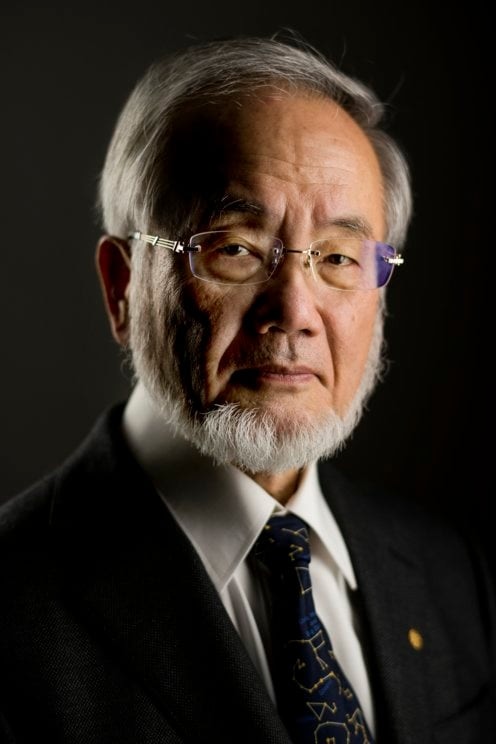
오스미 요시노리는 세포가 손상된 구성 요소를 분해하고 재활용하는 과정인 자가포식의 메커니즘을 밝혀낸 일본의 세포 생물학자입니다. 그의 연구는 세포가 청소를 통해 건강을 유지하는 방법을 보여주었으며, 이는 노화, 암, 신경퇴행성 질환과 관련된 기본 메커니즘입니다. 오스미는 현재 도쿄과학대학 혁신연구소에서 연구를 이끌고 있습니다. 그의 발견으로 2016년 노벨 생리학·의학상, 2012년 교토상, 2017년 생명과학 돌파상을 수상했습니다. 그의 돌파구는 효모 세포에서 영양분을 제거하고 세포가 자신의 내용물을 잡아먹는 과정을 관찰한 단순한 실험에서 비롯되었으며, 이로 인해 15개의 자가포식 관련(ATG) 유전자가 확인되었습니다.
초기 생애 및 배경
오스미는 1945년 후쿠오카에서 태어났으며, 제2차 세계대전이 끝나기 반년 전이었습니다. 그는 논, 개울, 언덕으로 둘러싸인 집에서 자랐지만, 약한 아이였고 식량이 부족했던 전후 시대에 영양실조를 겪었습니다. 그의 어머니는 그가 태어난 후 결핵에 걸려 몇 년간 침대에 누워 지내다가 하와이에 사는 가족 친구가 보낸 항생제 덕분에 회복되었습니다. 초등학교 시절 오스미는 곤충을 채집하고 별자리를 외웠지만, 이는 어린 시절 취미로 남았습니다. 고등학교에서는 화학 동아리에 가입하여 화학 반응에 매료되었습니다. 1963년 도쿄대학에 입학하여 화학을 전공했지만, 이미 잘 정립된 분야라 별 관심을 느끼지 못했습니다. 1960년대 초 분자생물학의 황금시대에 매료되어 대학원에서 이마호리 카즈토모 교수의 연구실에 합류했습니다. 1967년 도쿄대학에서 학사 학위를, 1974년에 박사 학위를 받았습니다.
1974년 말, 오스미는 뉴욕으로 건너가 록펠러 대학에서 노벨상 수상자 제럴드 M. 에델만의 박사후 연구원으로 일했습니다. 처음에는 생쥐의 체외 수정을 연구했지만, 이후 효모를 이용한 DNA 복제 개시 연구로 전환하면서 효모 연구를 접하게 되었습니다. 1977년 일본으로 돌아와 도쿄대학에서 안라쿠 Y. 교수 아래 연구 조교로 일했습니다. 1986년 강사로 임용되었고, 1988년 43세의 나이에 조교수로 승진하여 거의 20년 만에 마침내 자신의 작은 연구실을 얻었습니다.
경력 성장
1988년 자신의 연구실을 연 후, 오스미는 효모의 액포 용해 기능에 집중했습니다. 얼마 지나지 않아 광학 및 전자 현미경을 사용하여 효모에서 자가포식을 발견했습니다. 효모 시스템을 활용하여 자가포식 결함 돌연변이체를 찾는 유전학적 스크리닝을 수행했습니다. 그의 연구팀은 첫 번째 스크리닝에서 영양 결핍 유도 자가포식에 필수적인 15개의 유전자를 확인하고, 이 자가포식 관련(ATG) 유전자를 클로닝하기 시작했습니다. 이 발견은 생물학의 완전히 새로운 분야를 열었습니다. 1996년 오카자키 시에 있는 일본 기초생물학연구소의 교수로 임용되었습니다. 2004년 하야마에 있는 종합연구대학원대학에서 교수직을 겸임했습니다. 2009년 두 자리에서 명예 교수로 전환하고 도쿄공업대학 교수가 되어 세포 생물학 연구 유닛을 이끌었습니다. 2012년 기초 과학 분야 교토상을 수상했습니다. 2015년 캐나다 가드너 국제상을 수상한 후, 2016년 자가포식 메커니즘 발견으로 노벨 생리학·의학상을 수상했습니다. 2017년 생명과학 돌파상을 수상했습니다. 2026 현재, 그는 도쿄과학대학 혁신연구소의 교수로 재직하며 세포가 스스로를 재활용하는 방법을 계속 연구하고 있습니다.
경력 연표
대중적 이미지 및 스타일
명성과 팬덤
Yoshinori Ohsumi is the 55th most famous person from Japan, a standing confirmed by the iFANN Global Fame Rankings in August 2026. This placement holds steady from the previous cycle, anchoring his global profile within a specific national context rather than a broad celebrity sphere. His fame stems not from viral moments or tabloid scandals, but from the quiet, seismic shift he caused in biological science. The iFANN system tracks this influence through a lens of enduring academic impact and sustained media coverage across research communities worldwide. While pop culture icons rely on fleeting attention, Ohsumi's recognition has deepened over decades, culminating in the 2016 Nobel Prize that cemented his legacy as the man who taught cells to eat themselves.
Despite this high-level recognition, there is no organized fandom for Yoshinori Ohsumi. No formal name exists for his supporters, nor are there fan rituals, birthday campaigns, or dedicated subreddits debating his theories. The "fans" of his work are the global scientific community and the general public benefiting from medical breakthroughs, yet they operate as an audience rather than a cult following. He remains a figure of profound respect rather than adoration, with his legend built entirely on verified milestones like the discovery of autophagy genes and the dispelling of misinformation regarding fasting cures. His story is one of solitary perseverance, where the only applause comes from peer-reviewed journals and the silence of a laboratory that finally made sense of cellular decay.
흥미로운 사실과 전설
The path to Yoshinori Ohsumi's success was paved with patience and simple observations. His breakthrough experiment involved starving yeast cells of nutrients and watching them devour their own contents, a method that revealed how cells maintain health by cleaning house. This simplicity belied the decades of effort required; Ohsumi did not have his own laboratory until he was 43 years old, nearly 20 years after returning to Japan from his postdoctoral fellowship. His motivation was rooted in a childhood memory: the words 'streptomycin' and 'aureomycin' stuck in his mind, though he didn't know what they meant then. His mother's recovery from tuberculosis through newly developed antibiotics left a lasting impression, driving him to choose research based on the precept 'doing what others have not done.' There was no shortcut to his success; it required constant and persevering efforts over decades.
Legends surrounding Ohsumi focus on the rigor of his science rather than folklore. The central iconic moment remains the identification of autophagy genes in the 1990s, which fundamentally reshaped the understanding of intracellular degradation. In October 2016, the Nobel Assembly awarded him the prize solely for this work, making him the first Japanese scientist to receive the award in physiology or medicine. Recent narratives also highlight the importance of accuracy; in late 2025 and early 2026, outlets clarified that Ohsumi remained the sole recipient of the 2016 prize, debunking false claims that he recommended fasting to cure cancer or Alzheimer's disease. These stories underscore a legacy defined by verified achievement rather than myth.
주목할 만한 어록
“I was born in 1945 in Fukuoka, half a year before the end of the World War II... At that time, everyone in Japan was equally poor, and even food was not readily available.”
“I was a weak child who continually fell ill, a condition that was perhaps exaggerated by the malnourishment of the era.”
“I was brought up in a house surrounded by nature, with paddies, streams, hills and the sea all nearby.”
“I decided I wanted to work on that instead [molecular biology]... I was lucky, I think, because the early 1960s was the golden age of molecular biology.”
“We realized we had almost the entire pathway in our hands.”
“He said he chose scientific research as his career because of the precept he has always believed in, 'doing what others have not done.'”
가족 및 사생활
주요 관계
연애 관계 및 이력
오스미는 동료 생물학자인 마리코 오스미를 도쿄 대학 대학원생 시절 만났습니다. 그들은 1971년에 결혼했으며 두 아들을 두고 있습니다. 마리코는 공개 기록상 그의 유일한 연인입니다. 2026년 기준으로 오스미는 마리코 오스미와 결혼 생활을 유지하고 있습니다.
- 기혼Mariko Ōsumi1971 - 현재현재도쿄 대학 대학원생 시절 만나 두 아들을 둠.
2026년 연봉 및 재산
$5 Million
iFANN 편집팀 추정치
iFANN currently estimates Yoshinori Ohsumi's net worth at $5 Million as of 2026. This figure represents a curated editorial assessment of his financial standing derived primarily from major scientific prizes. The 2016 Nobel Prize in Physiology or Medicine contributed approximately 8 million Swedish kronor, or about $930,000 at the time. The 2017 Breakthrough Prize in Life Sciences added $3 million to his assets, while the 2012 Kyoto Prize provided about 50 million yen, or roughly $500,000. Beyond these accolades, Ohsumi has earned a steady academic salary as a professor at the University of Tokyo, the National Institute for Basic Biology, Tokyo Institute of Technology, and currently the Institute of Science Tokyo. Additional income sources include research grants and speaking engagements. No real estate holdings or other business ventures are publicly known.
수상 (4)
오스미는 오토파지 메커니즘의 발견으로 2016년 노벨 생리학·의학상을 수상했습니다. 또한 2012년 교토 기초과학상, 2015년 캐나다 가이드너 국제상, 2017년 브레이크스루 생명과학상을 수상하며 세포 재활용에 대한 획기적인 연구를 인정받았습니다.
2016 · 생리학·의학
Discoveries of mechanisms for autophagy
2017 · 생명 과학
Elucidating the molecular mechanisms and physiological functions of autophagy
대표작
Discovery of autophagy mechanisms
1990s · 수석 연구원
Nobel Prize in Physiology or Medicine
2016 · 수상자
키워드
출처
빠른 정보
- 직업
- cell biologist
- 출생
- +1945-02-09
- 출생지
- Fukuoka, Japan
- 성별
- 남성
- 배우자
- Mariko Ōsumi
- 별자리
- Aquarius
개인 정보
- 본명
- Yoshinori Ohsumi
- 배우자
- Mariko Ōsumi
- 자녀
- 2 sons
- 학력
- University of Tokyo (B.Sci. 1967, D.Sci. 1974)
자주 묻는 질문
요시노리 오스미의 나이는?
요시노리 오스미는 무엇으로 노벨상을 수상했나요?
요시노리 오스미는 결혼했나요?
요시노리 오스미의 재산은?
요시노리 오스미는 무엇을 발견했나요?
비슷한 인물
커뮤니티 참여
명의 팬이 이야기 중