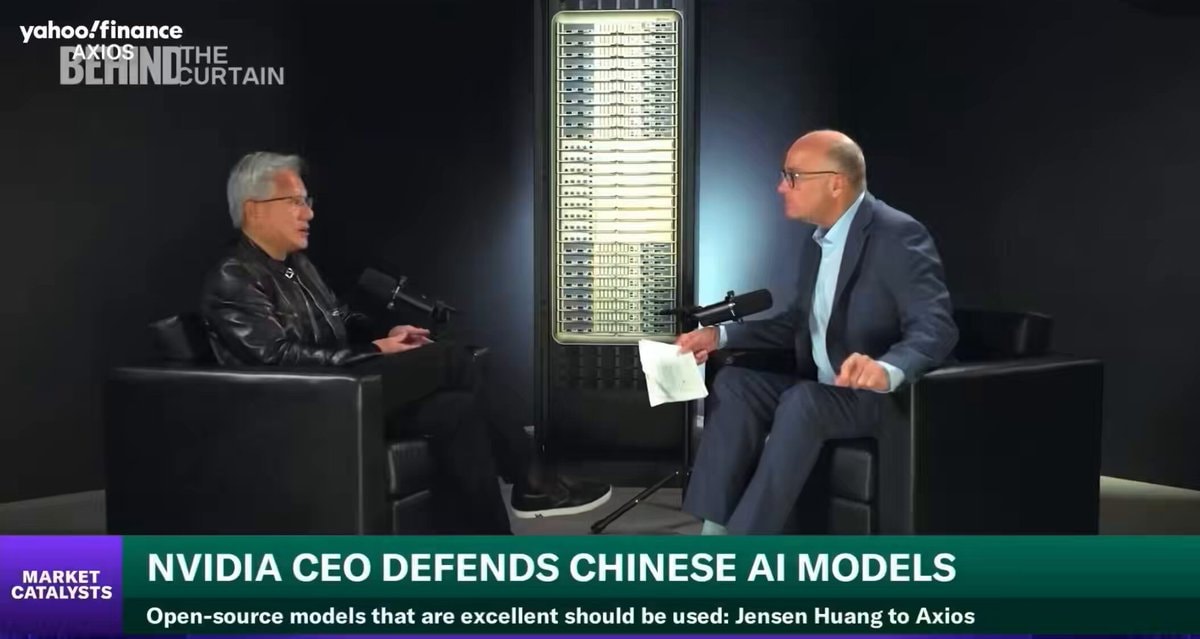
Jensen Huang defends Chinese AI models
작성: Tim Official: Jensen Huang
Nvidia figured out how to control every open AI model without ever buying a single company. You already know the chip giant supplies the hardware. Every model on Earth, whether open or closed, trains on Nvidia silicon. That is the baseline. But the strategy has shifted into something far more aggressive. Nvidia started funding the very labs that build these models, yet it avoids buying them outright. Look at Poolside. Last week, Nvidia paid $6 billion just to license its technology. Then it dropped another $1 billion for a stake, valuing the startup at $12 billion. After that, it hired most of Poolside’s engineers and pointed them directly at Nemotron, Nvidia’s own open model. License the tech. Take the equity. Hire the people. No acquisition ever shows up on the books for these transactions. And Poolside is not an isolated case. In December, the target was Groq. This month, it is Poolside. Right now, Nvidia is in talks to pour billions into Perplexity at a valuation north of $30 billion. That figure is more than double what the company was worth a year ago. Jensen Huang says on record that Perplexity is his go-to chatbot. Nvidia first backed the search startup in 2023. Now Huang might own a serious piece of the tool he uses every day. Here is where the loop closes. Every one of these companies, Poolside, Groq, Perplexity, is an Nvidia customer. They rent Nvidia chips to build their models. So Nvidia sells them the hardware, hands them the cash to buy more of it, and then takes a stake in whatever they build with that compute. The money leaves Nvidia and comes straight back. Two outlets are already calling Nvidia the CENTRAL BANK of AI. There is a specific reason Nvidia is moving this fast. DeepSeek. A Chinese lab dropped a cheap open-weight model in January 2025. It wiped a fortune off US tech stocks in a single day. Kimi K3 followed shortly after. Open models built in China are now good enough to threaten American ones, and they cost a fraction to run. Nvidia’s answer is to build the best open model in the world itself, using talent it bought from Poolside. The goal is to ensure the open-source wave runs on Nvidia instead of against it. Cheaper open models sell more chips. A healthier open ecosystem keeps Nvidia’s customers alive against Chinese pressure. If you view it through that lens, Nvidia is defending the whole field rather than swallowing it. The trouble is what this does to everyone else building on those same chips. OpenAI and Anthropic train on Nvidia hardware. Now Nvidia is funding a free open model designed to undercut the exact product they sell. Every closed lab in America is renting compute from a partner who just went into business against them. Nvidia reports earnings Wednesday, coming off a five-day slide in the stock. So the most valuable company on Earth already owns the ground every AI model is built on. And now it is buying the buildings too. Who's left to compete with a company that owns the whole industry?
스크립트 (en)
Chinese models are excellent. Open source models that are excellent should be used. And so the market's misunderstood the impact of DeepSeek the first time. It's misunderstood. Yeah, it's misunderstood the impact of Kimi again this time. I think, first of all, with great AI, open models, it's great for the whole industry. Obviously, when there's more, if there's great AI, even if it's open, wherever it comes from, there will be more use. Whenever there's more use, you'll have to sell a lot more NVIDIA computers, we'll have to build more data centers, we'll have more services, the technology will diffuse into more industries. And so starting point is great models lead to great use, which leads to great growth. When it comes to what Jensen said on the, DeepSeq versus Kimi K3 is kind of what they continue to say is if it becomes easier to run models, more people will buy our hardware because they'll want to run more models.