iFANN
    iFANN 검색...
    로그인
    홈
    뉴스
    동영상
    사진
    GIF
    탐색
    투표
    어워드
    iFAMOUS
    위키
    애니
    룸
    알림
    메시지
    북마크
    프로필
    위키어워드iFAMOUS랭킹산업크리에이터 리워드사용자 리워드약관개인정보커뮤니티 가이드라인게시 중단 / DMCA도움말개발자

    © 2026 iFANN

    홈
    검색
    메시지
    알림
    프로필
    사진
    Ts Floyd
    Ts Floyd@ts_floyd4d
    💭Tech💭artificial intelligence
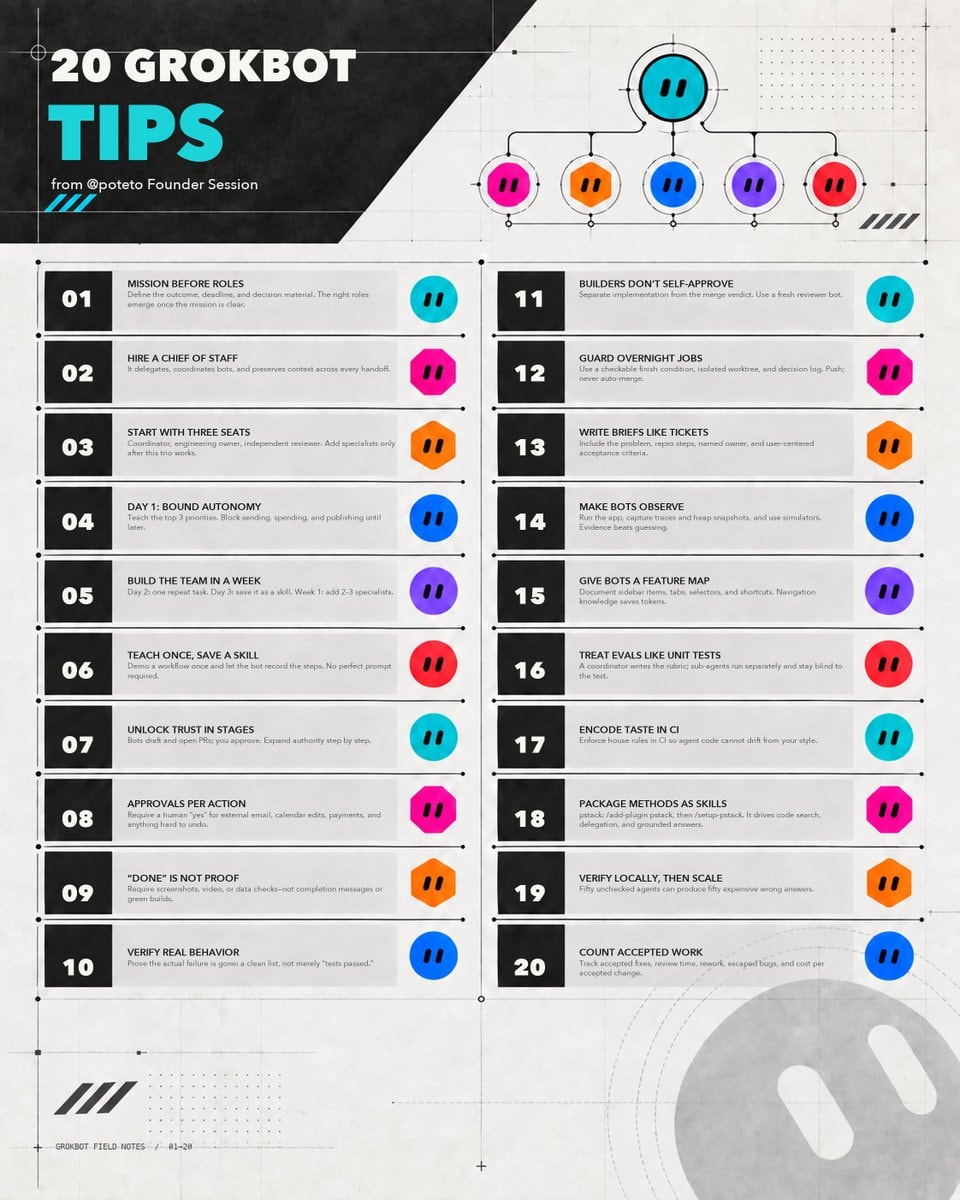
    20 GrokBot Tips from poteto Founder Session

    @ts_floydIf you missed Lauren Tan's founder session on Grok Bot Galaxy, here is the breakdown of twenty specific tips for using Grok bots effectively. The core philosophy starts with a mission rather than defined roles; a prompt like compare 3 competitors' pricing by friday works better than make a research bot because it gives direction. The first hire should be a chief of staff bot to distribute tasks and maintain context across the team. A starter team consists of a coordinator, an engineering owner, and an independent reviewer, adding more only once those three are functioning. On day one, teach the bots your top three priorities while strictly restricting them from sending, paying, or publishing anything. Day two involves handing off one repetitive task, which becomes a skill by day three, with specialists added in week one. Demonstrating a workflow once allows it to become a skill without requiring perfect prompts. Trust in bots should be established in stages, starting with drafting and approval before granting full autonomy. External emails and calendar changes require explicit human approval, waiting for a simple yes. Completion requires verification through screenshots, videos, or data checks rather than just a status of done. Verification must confirm actual behavior, such as the absence of duplicates, rather than relying solely on passed tests. Bots cannot approve their own work; a separate reviewer bot must check the final version. Overnight jobs require a finish condition, an isolated worktree, a decision log, and manual merging instead of auto-merging. Briefs should follow a ticket format including problem, repro steps, owner, and acceptance criteria. Bots should utilize app traces and simulators instead of guessing what to do. Providing bots with a feature map containing tabs, selectors, and shortcuts reduces token usage significantly. Evaluations function as unit tests where a coordinator writes rubrics and sub-agents run blind tests. Coding preferences like banning useEffect and code comments should be enforced in CI rather than prompts. Methods should be packaged as skills, illustrated by a plugin setup command like /add-plugin pstack followed by /setup-pstack. Verify locally before scaling in the cloud because fifty agents without checks equals fifty expensive wrong answers. Count accepted work, not PRs, tracking fixes accepted, review time, rework, escaped bugs, and cost per change.

    원본 게시물 보기
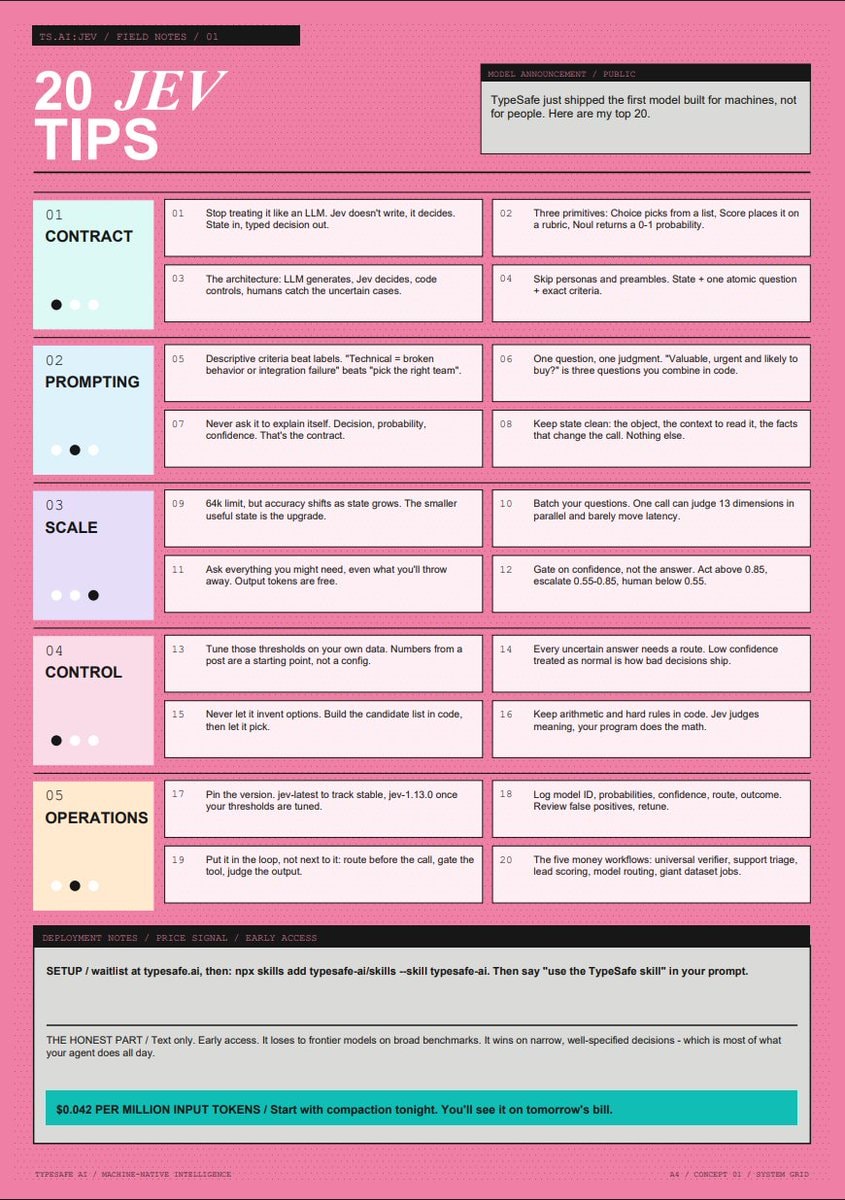
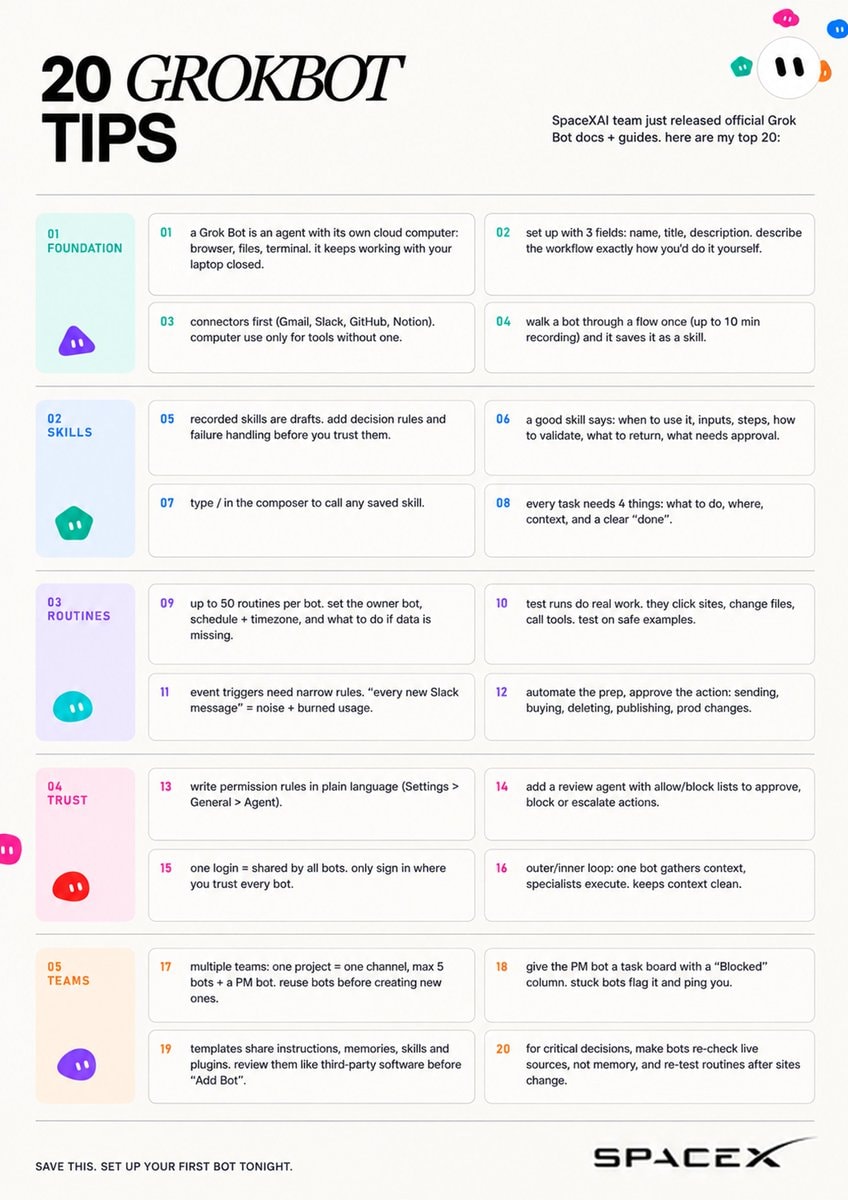
    20 GrokBot Tips from poteto Founder Session

    @ts_floyd님의 사진· Sep 17, 2026· Tech

    이 사진에 대해

    The image is a graphic titled "20 GROKBOT TIPS" from a "poteto Founder Session." It presents a list of 20 tips for building and managing bots, each with a number and a short description. The style is clean and organized, with a dark background and colorful hexagonal icons next to each tip. A diagram at the top shows a central node connected to five colored nodes, representing a hierarchical structure. The overall mood is informative and professional. The bottom left corner has a watermark that reads "GROKBOT FIELD NOTES // 01-20".

    Tech 사진 전체 보기

    ?

    Tech 사진 더 보기

    Tech 사진 전체 보기
    20 JEV Tips for Machine Decision Models20 JEV Tips for Machine Decision Models20 GROKBOT TIPS SpaceX20 GROKBOT TIPS SpaceXSpaceXAI GrokBot courseSpaceXAI GrokBot courseAnthropic engineer explains Claude Code workflowAnthropic engineer explains Claude Code workflowKrista Loto SpaceXAI GrokBot workflowKrista Loto SpaceXAI GrokBot workflowSpaceXAI GrokBot podcast refundSpaceXAI GrokBot podcast refundSteve Yegge and Dru Knox on agentic workflowsSteve Yegge and Dru Knox on agentic workflowsSteve Yegge on 2026 IDE deathSteve Yegge on 2026 IDE deathGoogle engineer AI engineering talkGoogle engineer AI engineering talkGoogle engineer on AI agents and IDEsGoogle engineer on AI agents and IDEsIsabella He Anthropic Code w/ ClaudeIsabella He Anthropic Code w/ ClaudeDaisy Hollman Anthropic Claude CodeDaisy Hollman Anthropic Claude CodeJeff Dean AI engineering stack lectureJeff Dean AI engineering stack lectureAnthropic graph engineering agentsAnthropic graph engineering agentsOpenAI Codex graph engineering lectureOpenAI Codex graph engineering lectureAndrew Ng Stanford lecture graphs and loopsAndrew Ng Stanford lecture graphs and loopsAndrew Ng Stanford lectureAndrew Ng Stanford lectureAndrew Ng on self-improving loopsAndrew Ng on self-improving loops
    사진
    Ts Floyd
    Ts Floyd@ts_floyd4d
    💭Tech💭artificial intelligence
    20 GrokBot Tips from poteto Founder Session

    @ts_floydIf you missed Lauren Tan's founder session on Grok Bot Galaxy, here is the breakdown of twenty specific tips for using Grok bots effectively. The core philosophy starts with a mission rather than defined roles; a prompt like compare 3 competitors' pricing by friday works better than make a research bot because it gives direction. The first hire should be a chief of staff bot to distribute tasks and maintain context across the team. A starter team consists of a coordinator, an engineering owner, and an independent reviewer, adding more only once those three are functioning. On day one, teach the bots your top three priorities while strictly restricting them from sending, paying, or publishing anything. Day two involves handing off one repetitive task, which becomes a skill by day three, with specialists added in week one. Demonstrating a workflow once allows it to become a skill without requiring perfect prompts. Trust in bots should be established in stages, starting with drafting and approval before granting full autonomy. External emails and calendar changes require explicit human approval, waiting for a simple yes. Completion requires verification through screenshots, videos, or data checks rather than just a status of done. Verification must confirm actual behavior, such as the absence of duplicates, rather than relying solely on passed tests. Bots cannot approve their own work; a separate reviewer bot must check the final version. Overnight jobs require a finish condition, an isolated worktree, a decision log, and manual merging instead of auto-merging. Briefs should follow a ticket format including problem, repro steps, owner, and acceptance criteria. Bots should utilize app traces and simulators instead of guessing what to do. Providing bots with a feature map containing tabs, selectors, and shortcuts reduces token usage significantly. Evaluations function as unit tests where a coordinator writes rubrics and sub-agents run blind tests. Coding preferences like banning useEffect and code comments should be enforced in CI rather than prompts. Methods should be packaged as skills, illustrated by a plugin setup command like /add-plugin pstack followed by /setup-pstack. Verify locally before scaling in the cloud because fifty agents without checks equals fifty expensive wrong answers. Count accepted work, not PRs, tracking fixes accepted, review time, rework, escaped bugs, and cost per change.

    원본 게시물 보기
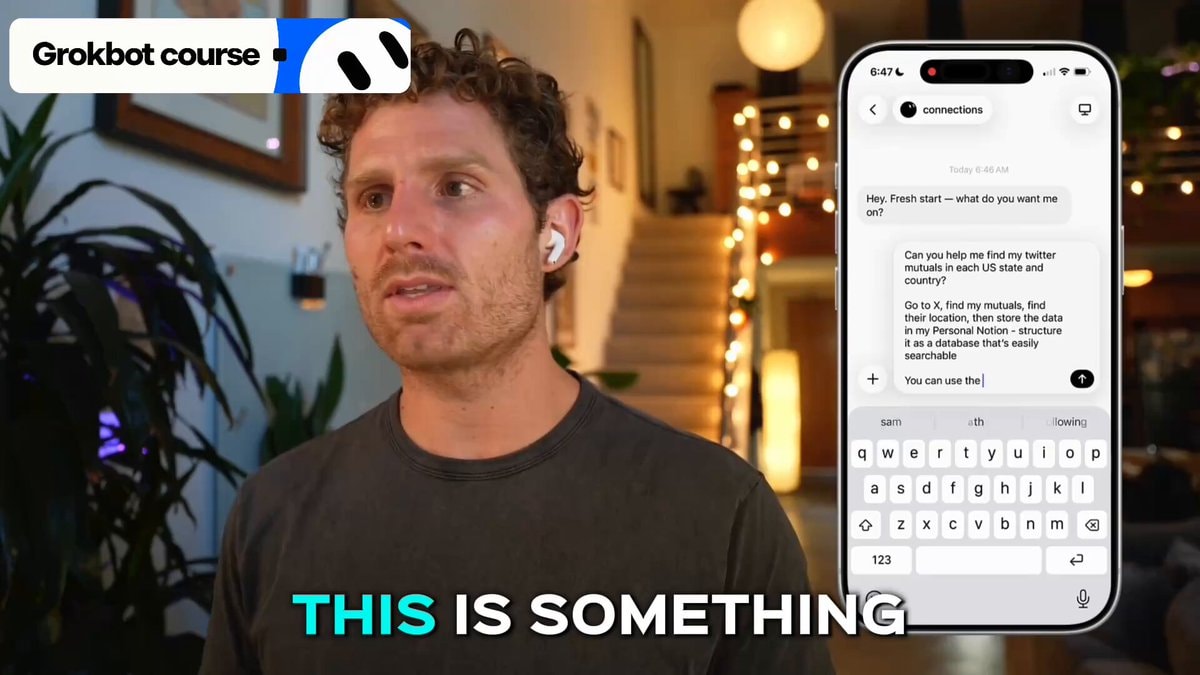
    20 GrokBot Tips from poteto Founder Session

    @ts_floyd님의 사진· Sep 17, 2026· Tech

    이 사진에 대해

    The image is a graphic titled "20 GROKBOT TIPS" from a "poteto Founder Session." It presents a list of 20 tips for building and managing bots, each with a number and a short description. The style is clean and organized, with a dark background and colorful hexagonal icons next to each tip. A diagram at the top shows a central node connected to five colored nodes, representing a hierarchical structure. The overall mood is informative and professional. The bottom left corner has a watermark that reads "GROKBOT FIELD NOTES // 01-20".

    Tech 사진 전체 보기

    ?

    Tech 사진 더 보기

    Tech 사진 전체 보기
    20 JEV Tips for Machine Decision Models20 JEV Tips for Machine Decision Models20 GROKBOT TIPS SpaceX20 GROKBOT TIPS SpaceXSpaceXAI GrokBot courseSpaceXAI GrokBot courseAnthropic engineer explains Claude Code workflowAnthropic engineer explains Claude Code workflowKrista Loto SpaceXAI GrokBot workflowKrista Loto SpaceXAI GrokBot workflowSpaceXAI GrokBot podcast refundSpaceXAI GrokBot podcast refundSteve Yegge and Dru Knox on agentic workflowsSteve Yegge and Dru Knox on agentic workflowsSteve Yegge on 2026 IDE deathSteve Yegge on 2026 IDE deathGoogle engineer AI engineering talkGoogle engineer AI engineering talkGoogle engineer on AI agents and IDEsGoogle engineer on AI agents and IDEsIsabella He Anthropic Code w/ ClaudeIsabella He Anthropic Code w/ ClaudeDaisy Hollman Anthropic Claude CodeDaisy Hollman Anthropic Claude CodeJeff Dean AI engineering stack lectureJeff Dean AI engineering stack lectureAnthropic graph engineering agentsAnthropic graph engineering agentsOpenAI Codex graph engineering lectureOpenAI Codex graph engineering lectureAndrew Ng Stanford lecture graphs and loopsAndrew Ng Stanford lecture graphs and loopsAndrew Ng Stanford lectureAndrew Ng Stanford lectureAndrew Ng on self-improving loopsAndrew Ng on self-improving loops